We conducted an analysis on how health systems facing historic funding cuts can leverage AIas a financial lifeline and unlock over $100M in impact within 3-5 years through strategic,system-wide deployment across high-impact areas.
Healthcare systems across the US are facing an unprecedented financial crisis, and it’s about to get worse.
With an expected $1 trillion reduction in government healthcare funding through 2034, healthcare leaders must act decisively to ensure organizational survival.
When implemented correctly, generative AI is increasingly becoming a force multiplier for regional health systems and academic medical centers (AMCs), delivering double-digit margin improvements in multiple cases.
In the next three years, the gap between health systems that scale AI effectively and those that hesitate will be measured in nine-figure differences to the bottom line.
The Coming Crisis: Understanding the Stakes
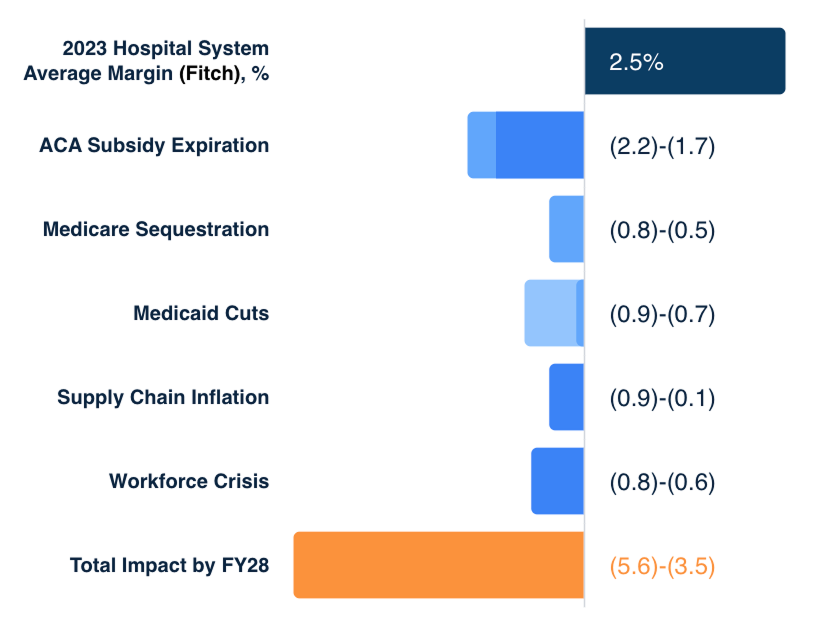
Healthcare systems are looking at pressures that could reduce operating margins by 3.5 to 5.6 percentage points by 2028, which could push them into negative margin territory within three years.
Five Critical Risk Factors Threatening Hospital Margins
1. ACA Subsidy Expiration (Starting FY2026)
Premium tax credit expiration and additional benefit restrictions could increase the uninsured population by 8.8 million, leading to lost revenue and higher uncompensated care.
2. Medicare Sequestration (Starting FY2027)
Federal spending cuts could trigger 2-4% Medicare reimbursement cuts.
3. Medicaid Cuts (Starting FY2028)
H.R. 1 provisions eliminate coverage for 10+ million Americans, leading to 40-50% increase in uncompensated care.
4. Supply Chain Inflation (Ongoing)
Tariff-driven cost increases create margin compression, with particular pressure on pharmaceutical and medical device costs.
5. Healthcare Workforce Crisis (Ongoing)
Labor shortages and 50% increase in resignations since 2020 drive labor compensation costs 1.2% above inflation without proactive intervention, these headwinds will fundamentally challenge hospital financial viability industry-wide within three years.
Our Findings: AI’s $100M Opportunity
Fortunately for healthcare systems and their patients, we have the tools that can stave off financial disaster. Generative and agentic AI already are making major inroads into healthcare, and the pending cuts will only accelerate their adoption.
We conducted a multi-source analysis to quantify AI’s potential impact for a $2B net patient service revenue (NPSR) health system.
Data Sources Synthesized in Our Methodology
- 2023 analysis - on estimated impacts of AI on healthcare spending
- Proprietary benchmarks from 10+ health systems - measuring both financial performance and realized AI-driven efficiencies
- Direct client data - tracking time-to-impact and ROI across our workflow automation deployments
Health systems executing comprehensive, well-governed AI strategies can capture 8–15% sustained margin improvement within 3–5 years—equivalent to 5x+ ROI.
For a $2B NPSR system, targeting high-return, rapid-deployment use cases with first-mover advantage, this translates into a $100M run-rate margin lift by 2028.
Impact of Effective Enterprise-Wide AI Transformation
For a $2B NPSR health system within 3-5 years
- 8-15% margin improvement
- $100M run-rate margin lift
- 5x+ return on investment
.png)
.png)
.png)
